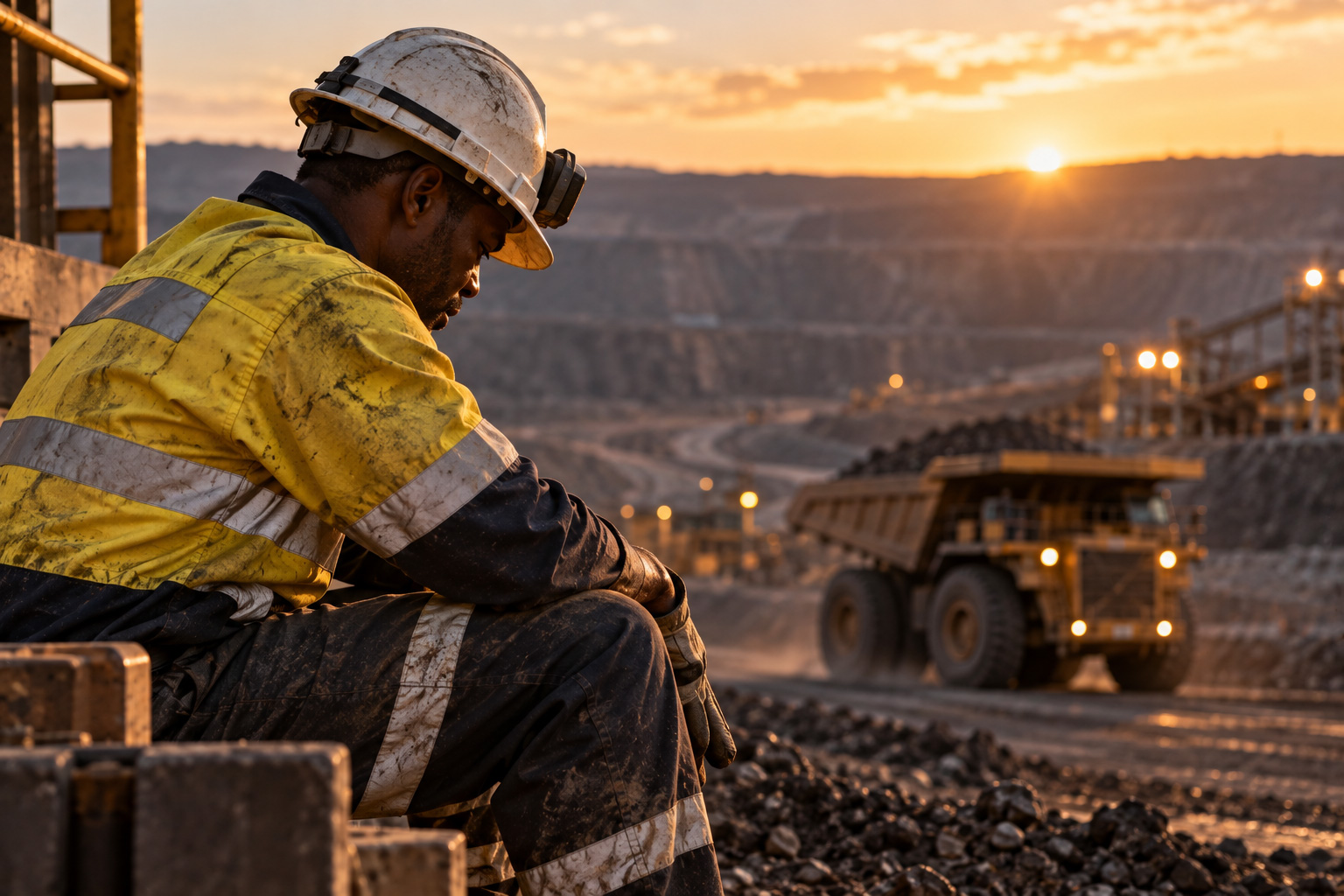
Fatigue Risk in Mining: When Tired Workers Become an Operational Risk
Mining operations are built around risk management.
Equipment is inspected. Hazards are identified. Procedures are documented. Workers are trained. Environmental conditions are monitored.
But one risk can be far more difficult to see.
Fatigue.
A fatigued employee may still arrive for their shift, wear the correct PPE and appear physically capable of performing the task.
What may not be immediately visible is reduced concentration, slower reaction time, poorer judgement and a greater likelihood of making mistakes.
In an industry where employees operate heavy machinery, work underground, drive long distances, perform safety-critical tasks and work rotating shifts, fatigue should not be treated simply as an individual problem.
It is an operational risk.
Fatigue Is More Than Feeling Tired
Everyone feels tired occasionally.
Fatigue becomes a workplace concern when physical or mental exhaustion begins reducing someone’s ability to perform safely and effectively.
The International Labour Organization notes that shift work and irregular working hours can disrupt normal sleep patterns and contribute to fatigue.
When workers are fatigued, they may experience:
- Reduced alertness
- Slower reaction times
- Difficulty concentrating
- Poorer decision-making
- Reduced situational awareness
- Difficulty processing information
- Increased irritability
- Short-term memory problems
In an office, a lapse in concentration may result in an incorrect spreadsheet.
On a mining operation, the consequences can be very different.
Mining Creates a Particular Fatigue-Risk Environment
Mining combines several factors that can contribute to fatigue.
These may include:
- Long or extended shifts
- Night work
- Rotating rosters
- Physically demanding work
- High temperatures
- Noise
- Remote locations
- Long commuting times
- Overtime
- Emergency call-outs
- Repetitive tasks
- Monotonous equipment operation
- Sleep disruption
The ILO’s mining guidance identifies both work-related and non-work-related causes of fatigue, including roster design, workload, overtime, environmental conditions and commuting time.
This is important because fatigue cannot always be solved by telling employees to “get more sleep”.
The design of the work itself matters.
South African Mining Already Recognises Fatigue as a Formal Risk
Fatigue is not a new issue for the South African mining industry.
The Mine Health and Safety Council’s promulgated guidelines include a dedicated Risk-Based Fatigue Management guideline alongside other mining safety and health guidance.
This reinforces an important principle:
Fatigue needs to be assessed and controlled as part of the wider health and safety management system.
It should not only become a topic after an incident occurs.
98 Degrees Group has previously discussed this broader approach in Managing Health and Safety Risks in the Mining Industry: A Proactive Approach, where fatigue and human error form part of the operational risk landscape that mines need to manage proactively.
Shift Work Can Disrupt the Body’s Natural Clock
Human beings are naturally designed to be awake during the day and asleep at night.
This internal cycle is often referred to as the circadian rhythm.
Night shifts and rotating work schedules can disrupt that rhythm.
An employee working through the night may therefore be required to remain alert during the period when their body naturally expects sleep.
Then, when the shift ends, they may need to sleep during daylight hours when environmental noise, family responsibilities, heat and normal daytime activity can make quality sleep more difficult.
The problem is not simply the number of hours someone spends in bed.
Sleep quality matters too.
A worker may technically have had several hours available for rest while still beginning the next shift insufficiently recovered.
Long Shifts Can Compound the Problem
Mining operations often require continuous production.
Long or compressed shifts can sometimes offer operational advantages and longer periods away from the workplace.
But they can also extend the period during which an employee needs to maintain concentration.
The ILO’s guidance on working time notes that extended workdays require careful consideration because shift systems should be designed to minimise the accumulation of fatigue.
The important issue is not simply asking:
How long is the shift?
Mining organisations should also consider:
- What work is being performed?
- At what point in the shift?
- How demanding is it?
- How many consecutive shifts have already been worked?
- Is the worker on days or nights?
- How much recovery time was available between shifts?
- Is overtime involved?
Ten hours performing one type of activity may present a very different fatigue profile from ten hours performing another.
Fatigue and Heavy Machinery Are a Dangerous Combination
Modern mining relies heavily on mobile and mechanised equipment.
Operators may be responsible for:
- Haul trucks
- Loaders
- Drilling equipment
- Underground machinery
- Conveying systems
- Lifting equipment
- Other trackless mobile machinery
These tasks require continuous awareness.
A brief lapse in concentration can be enough to create a serious event.
Fatigue can affect an operator’s ability to:
- Notice hazards
- Respond quickly
- Judge distance
- Maintain speed awareness
- Follow procedures
- Process changing information
- Recognise their own declining performance
This is why fatigue risk needs to be considered alongside equipment safety rather than separately from it.
Commuting Is Part of the Risk Picture
The working day does not necessarily begin when someone clocks in.
For many employees, getting to and from work adds substantial time to the day.
An individual may complete a long shift and then face a lengthy journey home.
That creates two separate concerns.
The first is whether the employee had enough opportunity to rest before the next shift.
The second is the risk of driving while fatigued immediately after work.
A roster that appears acceptable when only working hours are considered may look very different when commuting time is added.
The ILO specifically identifies commuting time as a factor that should be considered when assessing fatigue.
Heat Can Increase Physical Strain
Mining environments can expose employees to significant heat.
Physical work in hot conditions places additional demands on the body.
When heat, dehydration, physical exertion and insufficient rest occur together, employees may become exhausted more quickly.
Fatigue management should therefore connect with other occupational-health controls.
It cannot operate in isolation from:
- Thermal stress management
- Hydration
- Work-rest cycles
- Ventilation
- Physical workload
- Occupational medical surveillance
This reflects the broader approach of 98 Degrees Group’s Mining Advisory & Risk Solutions, which considers operational risk, workforce health, compliance and business continuity as interconnected issues.
Not All Fatigue Starts at Work
Employers can control working conditions.
They cannot control every part of an employee’s life.
A worker may arrive fatigued because of:
- A sick child
- Financial stress
- A second job
- Insomnia
- Sleep apnoea
- Alcohol use
- Certain medications
- Mental health difficulties
- Family responsibilities
This does not remove the organisation’s responsibility to manage workplace fatigue risk.
It simply means an effective system needs to recognise that there are multiple routes into fatigue.
Employees should also have a safe way to report when they are not fit to perform a safety-critical task.
A Culture of Silence Can Make Fatigue More Dangerous
One of the biggest obstacles to fatigue management is workplace culture.
In some environments, admitting that you are tired may be interpreted as weakness.
Workers may fear:
- Being disciplined
- Losing overtime
- Being viewed as unreliable
- Disappointing colleagues
- Being removed from desirable shifts
As a result, someone may continue working despite knowing that they are struggling to remain alert.
This is a problem.
An organisation cannot manage risks employees feel unable to report.
Fatigue reporting therefore needs to be treated in the same way as other safety reporting:
as information that allows the operation to manage risk before an incident occurs.
Supervisors Need to Know What to Look For
Fatigue is difficult to measure simply by looking at someone.
But supervisors can be trained to recognise possible warning signs.
These may include:
- Frequent yawning
- Difficulty keeping the eyes open
- Slower responses
- Reduced communication
- Unusual mistakes
- Poor coordination
- Irritability
- Forgetfulness
- Difficulty following instructions
- Reduced awareness of surroundings
None of these signs proves that someone is fatigued.
There may be other explanations.
But noticeable deterioration in performance should trigger a conversation.
Fatigue Risk Should Be Assessed Like Other Operational Hazards
An effective fatigue-management programme begins with understanding where the greatest exposure exists.
The risk assessment could consider:
- Shift duration
- Shift start and finish times
- Consecutive shifts
- Night work
- Overtime
- Break frequency
- Physical workload
- Monotonous work
- Environmental conditions
- Commuting requirements
- Safety-critical activities
- Previous fatigue-related incidents
- Near misses
The objective is to identify where fatigue and operational consequence intersect.
A tired employee performing a low-risk administrative task does not create the same exposure as a fatigued employee driving a loaded haul truck.
Risk controls should reflect that difference.
Rosters Are a Risk-Control Tool
Rosters are often designed primarily around production requirements.
But roster design is also a health and safety control.
Questions worth considering include:
- How many consecutive night shifts are being worked?
- Are employees receiving adequate recovery time?
- Is significant overtime becoming routine?
- Do shift-change patterns allow employees to adapt?
- Are particularly demanding tasks concentrated late in shifts?
- Are employees regularly called back during rest periods?
- Do commuting patterns reduce the actual rest window?
There is rarely one perfect roster for every mine.
The correct design depends on the nature of the operation, workforce and risk profile.
But the fatigue impact should be considered when rosters are developed or changed.
Breaks Matter
Breaks are not simply lost production time.
Appropriate breaks can help workers maintain alertness during demanding or monotonous tasks.
This can be especially important during:
- Long shifts
- Night work
- Repetitive activity
- Physically demanding work
- High-temperature exposure
- Extended equipment operation
The timing of breaks may also matter.
A short break before a high-risk task may provide more value than concentrating all rest periods during lower-risk parts of the shift.
Technology Can Support Fatigue Management
Technology is increasingly being incorporated into mining risk management.
Depending on the operation, fatigue-related technology may include:
- In-cab monitoring
- Driver-alertness systems
- Camera-based detection
- Wearable devices
- Digital shift records
- Overtime monitoring
- Real-time operational dashboards
- Incident trend analysis
Technology can help identify patterns.
But it should not replace good management.
A monitoring device cannot fix a roster that consistently creates insufficient recovery time.
Similarly, technology should not create a false sense that fatigue has been “solved”.
The strongest systems combine technology with:
- Risk assessment
- Work design
- Training
- Health support
- Appropriate supervision
- Employee reporting
Occupational Health Has an Important Role
Some employees may repeatedly experience fatigue even when working arrangements appear reasonable.
This can indicate an underlying health issue.
Conditions such as sleep apnoea, anaemia, diabetes, depression and certain cardiovascular problems can contribute to excessive tiredness.
Occupational-health programmes can therefore help identify situations where medical assessment may be necessary.
98 Degrees Group’s Mining Advisory & Risk Solutions specifically incorporate mining healthcare strategy and occupational-health support into the wider risk-management framework.
Fitness for work is not simply about whether someone can physically complete a task.
Alertness and cognitive functioning matter too.
Incident Investigations Should Consider Fatigue
After an incident, investigations frequently focus on immediate causes.
Was the correct procedure followed?
Was the equipment functioning?
Was the worker trained?
Was PPE being used?
Those questions matter.
But another question may be equally important:
Was fatigue a contributing factor?
This does not mean automatically blaming every mistake on tiredness.
Instead, investigations can consider:
- Hours worked before the incident
- Recent overtime
- Number of consecutive shifts
- Time of day
- Breaks taken
- Travel or call-out requirements
- Relevant medical concerns
If fatigue repeatedly appears in incident or near-miss patterns, the organisation may have a systemic risk rather than a series of unrelated human errors.
Human Error Often Has an Organisational Context
It is easy to describe an incident as “operator error”.
But the more useful question is:
Why did the error occur?
If a worker makes a poor decision during the tenth hour of a fourth consecutive night shift, fatigue may be part of the underlying context.
The International Labour Organization highlights working patterns, workload, shift timing and rest periods as factors organisations should assess where fatigue risk exists.
Human error should therefore not always be treated simply as an individual failure.
Sometimes it is a signal that a system needs attention.
Fatigue Management Is Also a Productivity Issue
Fatigue is usually discussed in relation to safety.
But it can also affect operational performance.
A fatigued workforce may experience:
- Reduced productivity
- Slower task completion
- Poorer decision-making
- More rework
- Equipment damage
- Increased absenteeism
- Lower morale
- More near misses
This means fatigue management sits at the intersection of health, safety and operational efficiency.
A well-rested workforce is not simply safer.
It is generally better positioned to perform consistently.
Leadership Sets the Tone
A fatigue policy has limited value if operational behaviour contradicts it.
For example, an organisation cannot tell employees to manage fatigue responsibly while regularly rewarding excessive overtime.
Managers and supervisors influence whether workers believe fatigue is genuinely taken seriously.
Leadership can support the process by:
- Monitoring excessive working hours
- Responding appropriately to fatigue reports
- Reviewing roster pressures
- Investigating recurring trends
- Encouraging safe reporting
- Avoiding production incentives that undermine fatigue controls
Safety culture is built through what leaders tolerate and prioritise in practice.
A Risk-Based Approach Is More Effective Than a Blanket Rule
Every mining operation is different.
Underground operations may face different fatigue pressures from open-pit operations.
Remote mines may have different commuting risks.
Highly mechanised operations may have different alertness requirements.
The goal should therefore not be a generic fatigue programme copied from another organisation.
It should be a risk-based system designed around the actual operation.
That may require input from:
- Operations
- Occupational health
- Safety teams
- Human resources
- Employees
- Shift supervisors
- Risk specialists
- Labour representatives
Fatigue management is most effective when it is integrated into existing operational systems rather than treated as a standalone wellness programme.
How 98 Degrees Group Can Support Mining Operations
98 Degrees Group provides specialised Mining Advisory & Risk Solutions designed around the realities of South African mining operations.
Our approach brings together:
- Operational risk
- Occupational health
- Workforce healthcare
- Compliance
- Employee wellbeing
- Insurance and employee benefits
- Business continuity
Fatigue management illustrates why an integrated approach matters.
A workforce issue can quickly become a safety issue.
A safety issue can become an operational interruption.
And an operational interruption can create financial and reputational consequences.
By understanding how these risks connect, mining organisations can build more resilient systems.
Fatigue Should Be Managed Before It Causes an Incident
Mining organisations already devote enormous attention to visible hazards.
Machinery.
Ground conditions.
Falls.
Dust.
Heat.
Electrical systems.
Fatigue deserves the same proactive thinking.
Because the worker who looks physically ready for duty may still be operating with reduced alertness and impaired judgement.
And in a safety-critical environment, that difference matters.
The question should not only be:
Did the employee arrive for the shift?
It should also be:
Are our systems designed to help employees perform that shift safely?
Build Safer, More Resilient Mining Operations
98 Degrees Group works with mining organisations to identify interconnected health, safety and operational risks and develop practical strategies suited to their operations.
Explore our Mining Advisory & Risk Solutions or read more about our approach to proactive mining health and safety risk management.
In mining, fatigue is not simply about being tired. It is about managing the conditions that allow people to work safely, consistently and effectively.